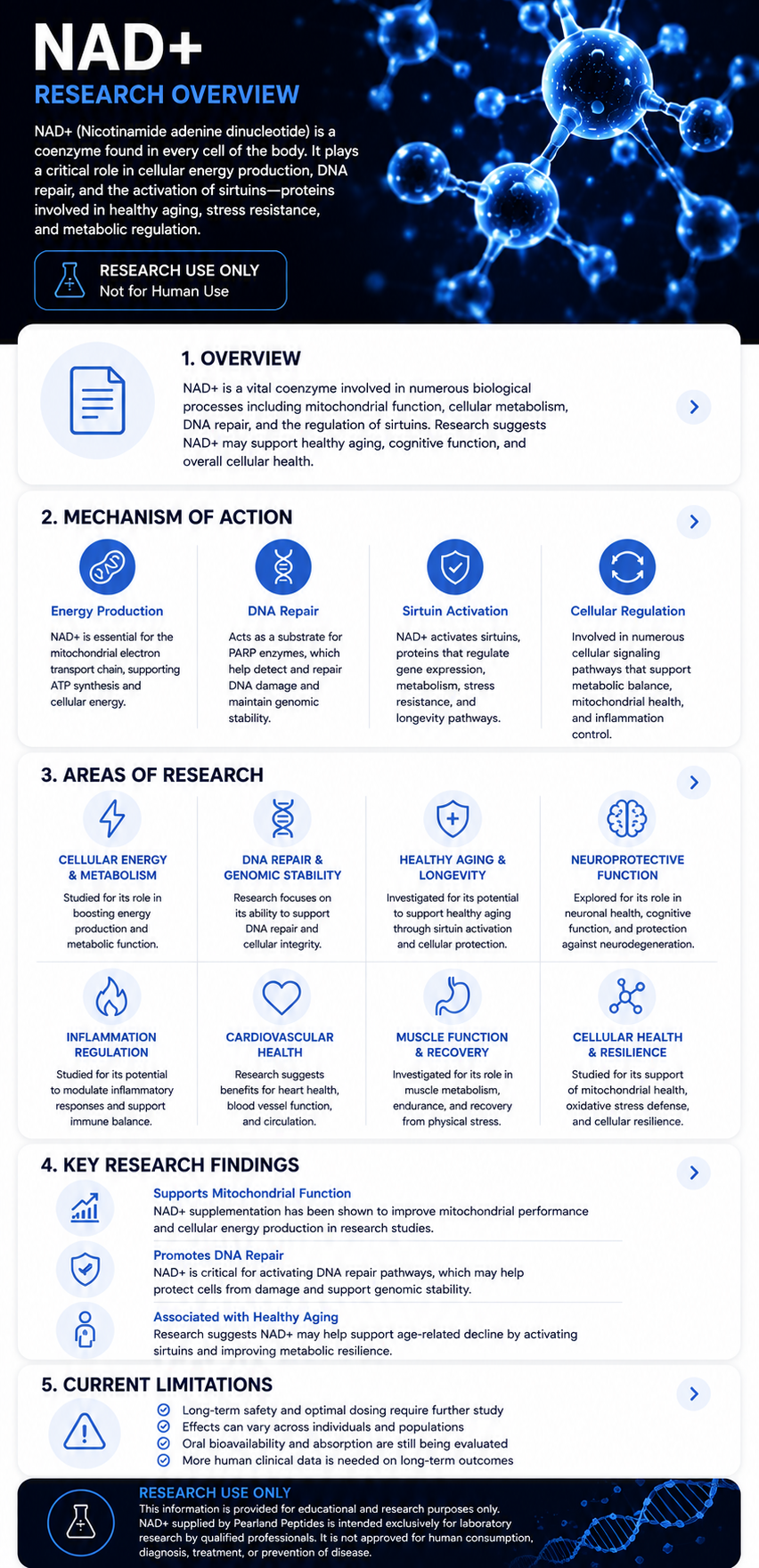
📚 Peer-Reviewed Research
Nicotinamide adenine dinucleotide (NAD+) is an essential cellular coenzyme involved in energy metabolism, redox reactions, DNA-repair signaling, and other metabolic processes. Direct human research on administered NAD+ remains limited; therefore, the research below clearly separates direct NAD+ studies from studies involving the NAD+ precursors nicotinamide riboside (NR) and nicotinamide mononucleotide (NMN).
Direct NAD+ Research
Intravenous Infusion of NAD+ Versus Nicotinamide Riboside: A Retrospective Tolerability Pilot Study in a Real-World Setting
Journal: Frontiers in Aging
Published: 2026
Study Type: Retrospective human pilot study
Summary
This small real-world study compared intravenous NAD+ with intravenous nicotinamide riboside. Researchers evaluated infusion time, tolerability, laboratory safety markers, and selected metabolic outcomes. Both interventions were associated with infusion-related symptoms, and the authors emphasized that larger controlled studies are needed before conclusions can be made about effectiveness or long-term safety.
Read Full Publication:
https://www.frontiersin.org/journals/aging/articles/10.3389/fragi.2026.1652582/full
DOI:
https://doi.org/10.3389/fragi.2026.1652582
A Pilot Study Investigating Changes in the Human Plasma and Urine NAD+ Metabolome During a Six-Hour Intravenous NAD+ Infusion
Journal: Frontiers in Aging Neuroscience
Published: 2019
Study Type: Human pharmacokinetic pilot study — landmark direct NAD+ study
Summary
This study tracked NAD+ and its metabolites in plasma and urine during a six-hour intravenous NAD+ infusion. Researchers observed that infused NAD+ was rapidly metabolized and documented changes in several related metabolites. The study primarily examined pharmacokinetics and metabolism rather than clinical benefits.
Read Full Publication:
https://www.frontiersin.org/journals/aging-neuroscience/articles/10.3389/fnagi.2019.00257/full
View on PubMed:
https://pubmed.ncbi.nlm.nih.gov/31572171/
Human Research on NAD+ Precursors
The Differential Impact of Three Different NAD+ Boosters on Circulatory NAD and Microbial Metabolism in Humans
Journal: Nature Metabolism
Published: 2026
Study Type: Randomized, open-label, placebo-controlled human study
Summary
Researchers compared nicotinamide, NR, NMN, and placebo in 65 healthy adults. Fourteen days of NR and NMN supplementation approximately doubled baseline whole-blood NAD+ concentrations, while nicotinamide produced a more temporary acute effect. The study also investigated how gut-microbial metabolism may contribute to the NAD+-raising effects of NR and NMN.
Read Full Publication:
https://www.nature.com/articles/s42255-025-01421-8
DOI:
https://doi.org/10.1038/s42255-025-01421-8
A Randomized Placebo-Controlled Trial of Nicotinamide Riboside in Older Adults With Mild Cognitive Impairment
Published: 2024
Study Type: Randomized, placebo-controlled human pilot study
Summary
Older adults with mild cognitive impairment received NR or placebo. NR significantly increased blood NAD+ concentrations and was generally well tolerated, but the study did not demonstrate an improvement in cognition during the treatment period.
View on PubMed:
https://pubmed.ncbi.nlm.nih.gov/37994989/
Read Full Text:
https://pmc.ncbi.nlm.nih.gov/articles/PMC10828186/
Ingestion of β-Nicotinamide Mononucleotide Increased Blood NAD+ Levels, Maintained Walking Speed, and Improved Sleep Quality in Older Adults
Journal: GeroScience
Published: 2024
Study Type: Double-blind, randomized, placebo-controlled human study
Summary
This study evaluated NMN supplementation in older adults. Researchers reported increased blood NAD+ levels, maintenance of walking speed, and improvements in selected sleep-quality measures. No test-product-related adverse effects were reported during the study.
View on PubMed:
https://pubmed.ncbi.nlm.nih.gov/38789831/
DOI:
https://doi.org/10.1007/s11357-024-01204-1
Nicotinamide Riboside for Peripheral Artery Disease
Published: 2024
Study Type: Randomized, double-blind clinical trial
Summary
This six-month study evaluated NR, with or without resveratrol, in adults with peripheral artery disease. Participants receiving NR demonstrated improvement in six-minute walking performance compared with placebo. The findings relate specifically to NR supplementation and should not be presented as direct evidence for administered NAD+.
View on PubMed:
https://pubmed.ncbi.nlm.nih.gov/38871717/
Review Articles
Regulation of and Challenges in Targeting NAD+ Metabolism
Journal: Nature Reviews Molecular Cell Biology
Published: 2024
Study Type: Scientific review
Summary
This review examines NAD+ metabolism, cellular NAD+ pools, precursor pathways, microbiome involvement, supplementation strategies, and unresolved safety and translational questions. The authors emphasize that NAD+ biology is complex and that raising blood NAD+ does not automatically establish a clinical benefit.
Read Publication:
https://www.nature.com/articles/s41580-024-00752-w
DOI:
https://doi.org/10.1038/s41580-024-00752-w
NAD+ Supplementation for Anti-Aging and Wellness
Published: 2026
Study Type: Systematic review
Summary
This review evaluated human evidence involving NAD+, NADH, NR, NMN, and related NAD+-raising interventions. The authors found consistent evidence that several strategies can alter NAD+-related biomarkers, but concluded that clinical effectiveness for general anti-aging and wellness outcomes remains uncertain.
View on PubMed:
https://pubmed.ncbi.nlm.nih.gov/41655607/
Additional NAD+ Publications
Browse current PubMed research:
https://pubmed.ncbi.nlm.nih.gov/?term=NAD%2B+supplementation
Research Disclaimer
This Research Library summarizes published scientific literature for educational purposes only. Pearland Peptides products are intended For Research Use Only and are not for human consumption or medical use.